What Is Amazon Rufus and COSMO? A Plain-English Guide for Amazon Sellers
How Amazon's AI shopping systems evaluate your listing, and what every seller needs to know in 2026.
Amazon
Peter Zdravkovski
Amazon Alexa for Shopping (formerly Rufus) is a conversational AI shopping assistant built into the Amazon app and website. COSMO is the intent engine underneath it that determines which products to recommend. Together, they evaluate your listing not for the keywords it contains, but for the problems it solves. Sellers whose listings communicate clear intent signals get recommended. Sellers who rely on keyword density get skipped.
Over 300 million customers used Rufus in 2025. Amazon reported nearly $12 billion in incremental annualized sales driven by Rufus interactions. Shoppers who engage with Rufus complete purchases at roughly 60% higher rates than those using standard keyword search. This is not an experimental feature. It is how a growing share of Amazon's highest-intent buyers find products.
Understanding what Rufus and COSMO actually are is the first step to doing something about it.
Notice: Rufus and Alexa might be used interchangeably throughout the article since the Alexa integration is a recent event and outright removing “Rufus” from the conversation might be confusing for some readers.
What Is Amazon Rufus?
Amazon Rufus is a generative AI shopping assistant embedded in the Amazon Shopping app and website. Instead of typing a keyword and scrolling through results, shoppers ask Rufus questions in plain language.
"What shoes are good for someone on their feet all day?"
"I need a gift for a 7-year-old who loves science."
"Compare these two blenders."
Rufus (now Alexa for Shopping) reads your listing, customer reviews, Q&A section, and product images, then generates a recommendation. If your listing clearly communicates what the product does, who it is for, and when it is useful, Rufus can confidently surface it. If it cannot answer the shopper's question from your content, it moves on to a product that can.
Amazon launched Rufus in beta in February 2024. By 2025, over 300 million customers had used it, with monthly active users growing 149% year-over-year and total interactions up 210% in the same period.

What Is Amazon COSMO?
COSMO (Common Sense Knowledge Generation) is the AI system running underneath Alexa. It is what gives Alexa the ability to understand intent rather than match keywords.
Amazon's research team published the COSMO paper at the ACM SIGMOD conference in 2024. COSMO works by analyzing hundreds of millions of real shopper behaviors, including search-to-purchase patterns and co-purchase patterns, to build a vast knowledge graph of how products relate to human needs, activities, life situations, and contexts. That knowledge graph spans 18 major product categories and contains millions of intent relationships.
A concrete example from the paper: a shopper searching "shoes for pregnant women" never types the words "slip-resistant" or "arch support." COSMO infers those needs automatically, because its knowledge graph has learned that pregnant women typically require those attributes.
Products whose listings communicate those capabilities get surfaced. Products that do not, get filtered out.
The old A9 algorithm asked: does this listing contain the words the customer typed? COSMO asks: does this product solve the problem the customer described?
What Is Alexa for Shopping?
In 2026, Amazon merged Rufus and Alexa+ into a single experience called Alexa for Shopping, available to all U.S. customers on the Amazon Shopping app, website, and Echo Show devices. No Prime membership is required.
The key change: Alexa for Shopping is now accessible directly from the main Amazon search bar, not just a separate chat window. Shoppers can ask questions, compare products, set price alerts, schedule recurring purchases, and build carts through conversation.
For sellers, the implication is direct. The conversational shopping layer is no longer a sidebar feature. It is becoming the primary interface through which high-intent buyers find and purchase products on Amazon.
How Alexa and COSMO Work Together
Alexa is the interface. COSMO is the brain.
When a shopper asks Alexa a question, COSMO evaluates which products in the catalog are actually relevant to what the shopper is trying to accomplish. Alexa then presents those products conversationally, with an explanation of why each one fits the need.
This is why a listing can rank well in traditional Amazon search and still get passed over by Alexa. Keyword presence gets you considered. Intent signals get you recommended.
A9 Still Exists: The Three-Layer Model
A common misconception is worth addressing head-on: COSMO does not replace Amazon's A9 search algorithm. All three systems run simultaneously.
A9 indexes your listing and determines whether it enters the initial candidate pool for a search. Keywords still matter here.
COSMO evaluates how well your listing communicates intent signals and ranks relevance within that candidate pool.
Rufus / Alexa for Shopping surfaces the most relevant products conversationally to the shopper.
Think of it this way. A9 gets you into the room. COSMO decides where you sit. Rufus decides whether you get introduced.
Sellers who optimize for all three layers hold an advantage over those still writing for A9 alone.
Why Most Listings Are Not COSMO-Ready
The majority of Amazon listings were written for a keyword-matching system. They are structured around search volume, repetition, and indexing logic rather than around communicating intent.
COSMO cannot reliably recommend a product it cannot confidently understand. A listing that reads "premium stainless steel water bottle, BPA-free, 20oz, insulated, leak-proof, gym, office, travel" gives COSMO very little to work with.
A listing that reads "keeps drinks cold for 24 hours, fits standard car cup holders, tested in gym bags and backpacks" gives it exactly what it needs.
The practical side of this, including how to audit your listing against COSMO's framework, is covered in the companion post: [How to Optimize Your Amazon Listing for Rufus and COSMO in 2026.]
Frequently Asked Questions
Does Amazon Rufus replace the A9 search algorithm?
No. A9 still governs keyword indexing and determines whether your listing enters the search candidate pool. COSMO layers on top of A9 to evaluate intent relevance within that pool. Rufus uses COSMO to surface products conversationally. All three run simultaneously, and sellers need to satisfy all three.
How many customers use Amazon Rufus?
Over 300 million customers used Rufus in 2025, with monthly active users growing 149% year-over-year. Amazon reported nearly $12 billion in incremental annualized sales tied to Rufus interactions, confirming it is now a core part of Amazon's revenue strategy.
What is the difference between Rufus and Alexa for Shopping?
Alexa for Shopping is the name for the merged Rufus and Alexa+ experience launched in 2026. It incorporates Rufus's product expertise alongside Alexa's personalized context drawn from across Amazon devices. It is accessible from the main Amazon search bar as well as the dedicated chat window, making it a more central part of the shopping experience.
Do keywords still matter for Amazon listings in 2026?
Yes. Keywords remain important for A9 indexing, which determines whether your product enters the candidate pool. The shift is that keyword presence alone is no longer sufficient. COSMO evaluates intent signals within that pool. Listings with both strong keyword coverage and clear intent context outperform those that have only one.
What is COSMO based on?
Amazon's COSMO research paper, published at ACM SIGMOD 2024, describes COSMO as a knowledge graph built from hundreds of millions of real shopper behaviors, covering search-to-purchase and co-purchase patterns. It spans 18 major Amazon product categories and contains millions of intent-based knowledge relationships connecting products to human needs, activities, audiences, and use contexts.

Master the Marketplace.
Actionable strategies to boost your organic ranking and maximize your CTR, delivered weekly.
Other Blogposts
Amazon
Best AI Tools for Amazon Sellers in 2026 (By Use Case)
The right tool depends on what you're trying to fix. Here's the breakdown by use case.
Amazon
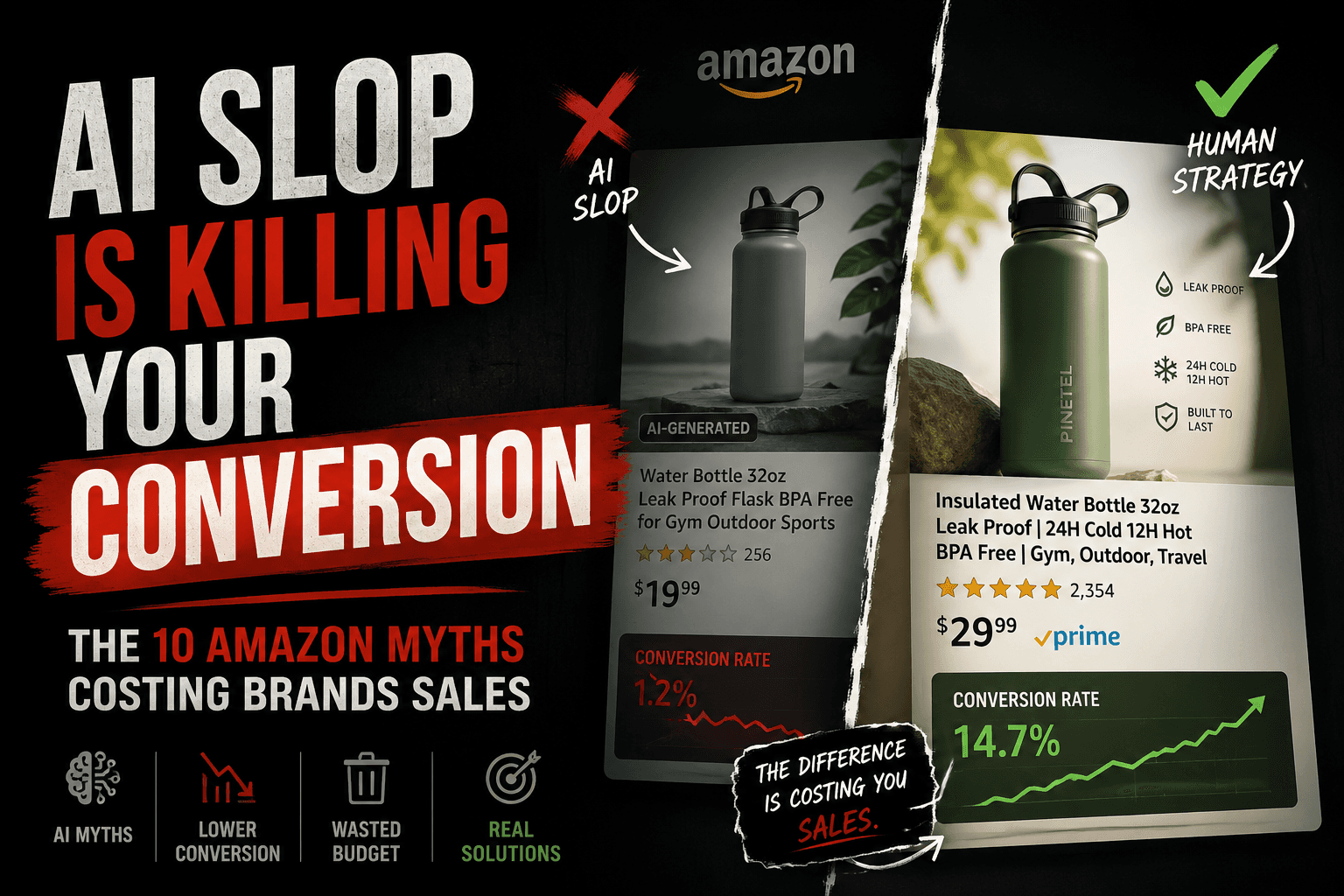
The AI slop quietly killing your Amazon conversion
Most AI-generated listings look polished, keyword-optimized, and technically correct. So why are conversion rates collapsing? Here are the 10 AI myths quietly hurting Amazon brands in 2026.
Amazon
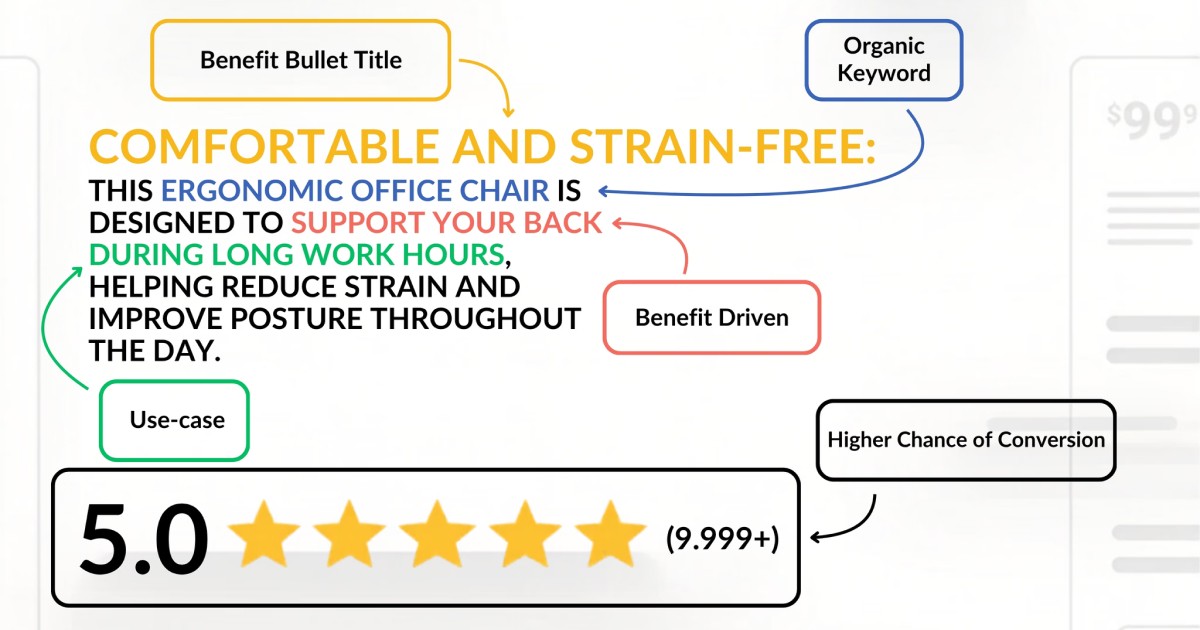
What Is a Good Product Description for Amazon?
and an Example you can follow to improve your product description